Forget Pumpkin Spice— Fall Harvest Season Is Quickly Approaching!

It's September, which means pumpkin spice has once again found its way into just about everything.
Coffee. Candles. Cookies. Cereal. Probably something that has absolutely no business being pumpkin spice.
But while everyone else is thinking about pumpkin spice, we're starting to think about actual pumpkins—and broccoli, cabbage, kale, herbs, pigs, poultry and all of the other things that come along with the fall harvest.
Because at Piggyback Treats, harvest season has always looked a little different.
Sometimes, our harvest doesn't even begin until everyone else is finished!

There’s Still Good Food in Those Fields
At the end of the growing season, there is often still perfectly good food left in the fields. Broccoli, cabbage, kale, herbs and other vegetables may remain after a farm has finished harvesting what it can sell. Before those fields are cleared and what's left is returned to the earth, we're sometimes invited to come through and gather what we can use.
It's an old agricultural practice called gleaning—collecting usable food and crops that remain in the fields after the primary harvest—and people have been doing it for a very long time.
Our version just happens to be for pets!
Instead of asking our farmers to grow crops specifically for us, we can make use of much of what's already there. Those end-of-season vegetables and herbs can find their way into our kitchen and eventually into broths, foods, treats and other goodies for the animals who share our homes.
Our Harvest Starts After Halloween
Pumpkins are one of our favorite examples of what it means to Piggyback.
Every year after Halloween, when the pumpkin patches have closed for the season, we head back into the fields. Over the years, we've invited friends, customers and staff to come along with us, gathering the pumpkins still sitting in the fields after the season has ended.
It's fun. It's usually a little dirty. And we inevitably end up with a LOT of pumpkins.
We've found another way to piggyback on pumpkin season, too!
A local composting company, Back To Earth Compost, collects pumpkins after Halloween and sets aside the intact, un-carved ones for us to use. The pumpkins that aren't suitable for us can continue on their way into the compost stream, while the ones that are still good food get one more stop along the way. They come to us.
Because here's the funny thing about pumpkins: A perfectly good pumpkin, at midnight on October 31st, somehow goes from something everybody wants to something nobody knows what to do with.
We know what to do with them!
Fall Harvest Isn't Just Vegetables
When we talk about harvest season, though, we're not only talking about what grows from the ground. For many of the small farms we work with, autumn is also butchering season.
We intentionally choose to work with farms raising animals on pasture, and many small farms don't raise certain livestock through the winter. Pigs and poultry that have spent the warmer months outside on pasture are often processed as the season comes to an end.
And that means another kind of harvest begins for us.
The familiar cuts generally already have somewhere to go—the chicken breasts and thighs, pork chops, roasts and other things people expect to see at the butcher counter.
But an animal is so much more than those familiar cuts.
There are hearts and livers. Feet and necks. Heads and skin. Tracheas, esophagus and other parts that may have much less demand in our modern human food system.
For us—and for the dogs and cats we're feeding—those parts have tremendous value. That's one of the reasons our relationships with our farmers matter so much. We aren't asking a farm to raise an animal because we need chicken feet. The chickens are already being raised for food.
Today, you might hear this described as whole-animal utilization or nose-to-tail eating. To us, it has always just made sense: if an animal was raised for food, we should value and use as much of that animal as possible.
We're simply there to ask:
What else do you have that you don't have a customer for?

That's the “Piggyback”
It's quite literally how Piggyback Treats got its name.
We've spent years building relationships with small family farms, fishermen, hunters, food producers and other local businesses. Instead of beginning with a shopping list and demanding that someone produce exactly what we need, we begin by finding out what they have.
Today, you may hear ingredients like these described as upcycled ingredients, and products made from them as upcycled pet food or upcycled dog treats.
When we started Piggyback Treats, we simply called it piggybacking—finding valuable, nutritious ingredients already being produced within our local food system and giving them another place to go.
What are you growing?
What are you raising?
What's abundant right now?
What isn't being fully utilized?
What can we make use of?
That means sourcing this way isn't always predictable.
Sometimes we're gathering the last kale and herbs from a field before it's cleared.
Sometimes a farmer has chicken feet, necks or organs.
Sometimes it's pork hearts or other parts of a pig that don't have the same demand as the chops and roasts.
Sometimes it's the skin of a fish whose fillets are headed for someone's dinner.
And sometimes it's a phone call we weren't expecting that leaves us figuring out where on earth we're going to put a few hundred pounds of something.
That's part of the fun.
It's also part of working with the natural rhythm of farms and food instead of expecting ingredients to appear whenever we decide we want them.
And Now, We Piggyback on Ourselves, Too
In more recent years, some of these ingredients have found yet another place to go. Our “sister company,” Farm N’ Sea Pets—technically an entirely separate business, but very much part of the same family—focuses on fresh, biologically appropriate raw food for dogs and cats.
And it turns out the ingredients we've spent years building relationships to source for Piggyback are also some of the ingredients we want in their daily food bowls.
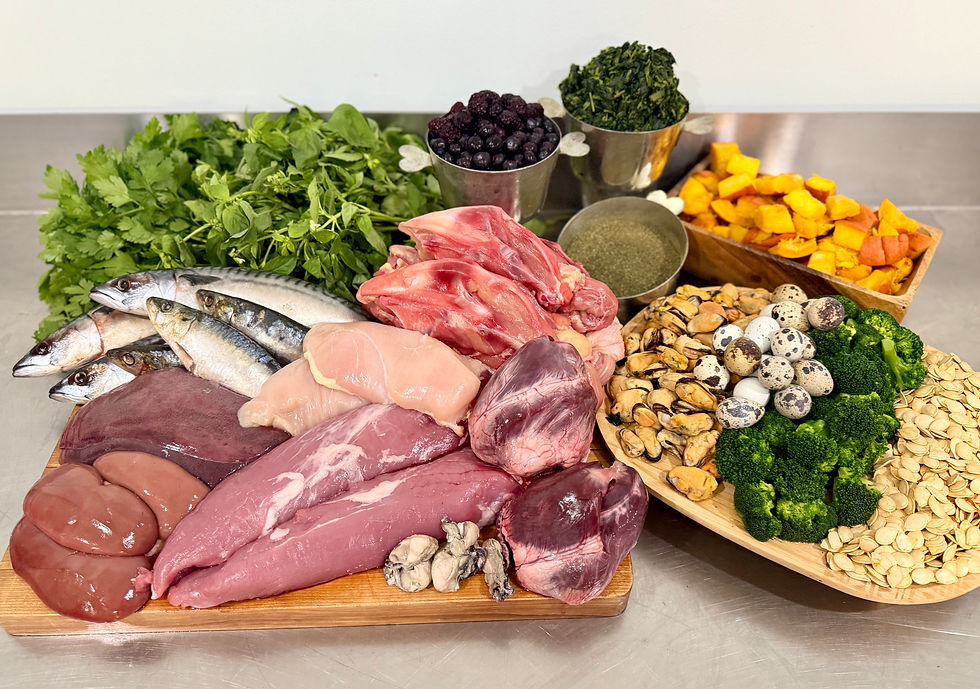
Organs, raw meaty bones, seafood, vegetables, herbs and other nutrient-rich foods that come through these farm relationships can become part of Farm N’ Sea Pets' raw food blends, individual raw feeding ingredients and treats.
It has given us even more opportunities to use what our farmers have available.
A chicken back, for example, doesn't necessarily need to become a treat. It can be finely ground and used as a raw meaty bone. Hearts and other organs can become part of a balanced food blend. Vegetables and herbs we've gathered from the fields can become ingredients in fresh foods.
In a funny way, Farm N’ Sea has allowed us to take the original Piggyback idea even further.
The question is still the same: What do you have, and how can we use it? Only now, the answer doesn't always have to be a treat.
There Is More to a Harvest
Sustainability is a word that gets used a lot these days.
For us, it has never been about finding a clever way to put that word on a package. It's about looking at what we already have and recognizing its value.
A broccoli plant still standing at the end of the season.
Herbs that won't survive the coming frost.
The parts of an animal that aren't destined for the butcher case.
A fish skin left after the fillet has been removed.
Or a perfectly good pumpkin that suddenly became obsolete because the calendar changed.
To us, none of those things are lesser ingredients.
They're valuable resources that simply need somewhere else to go.
That's where we come in.
For us, reducing food waste isn't about turning something worthless into something useful. It's about recognizing that much of what our food system calls “waste” was valuable food all along—it simply needed somewhere else to go.
So yes, pumpkin spice season is here, but at Piggyback Treats, we're looking forward to something much better.
The harvest that comes AFTER the harvest!
And we can't wait to see what our farmers have for us this year!


Comments